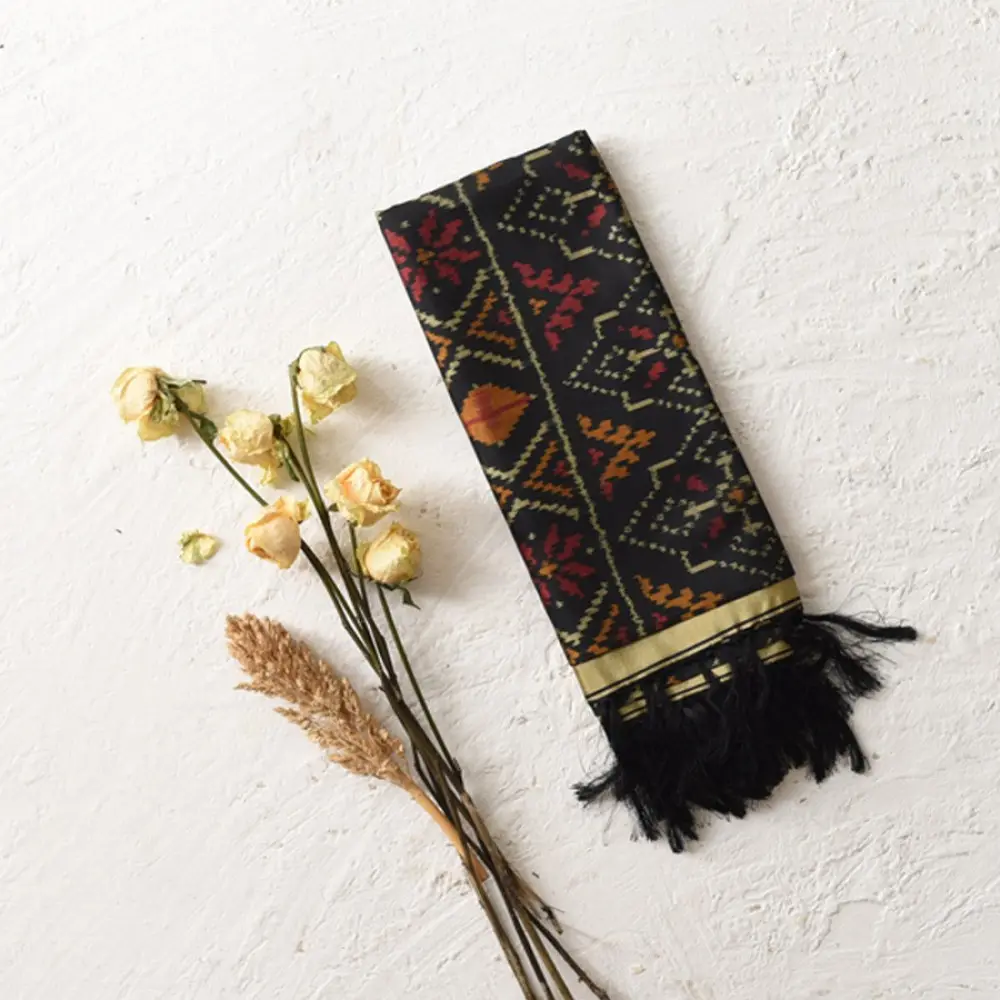
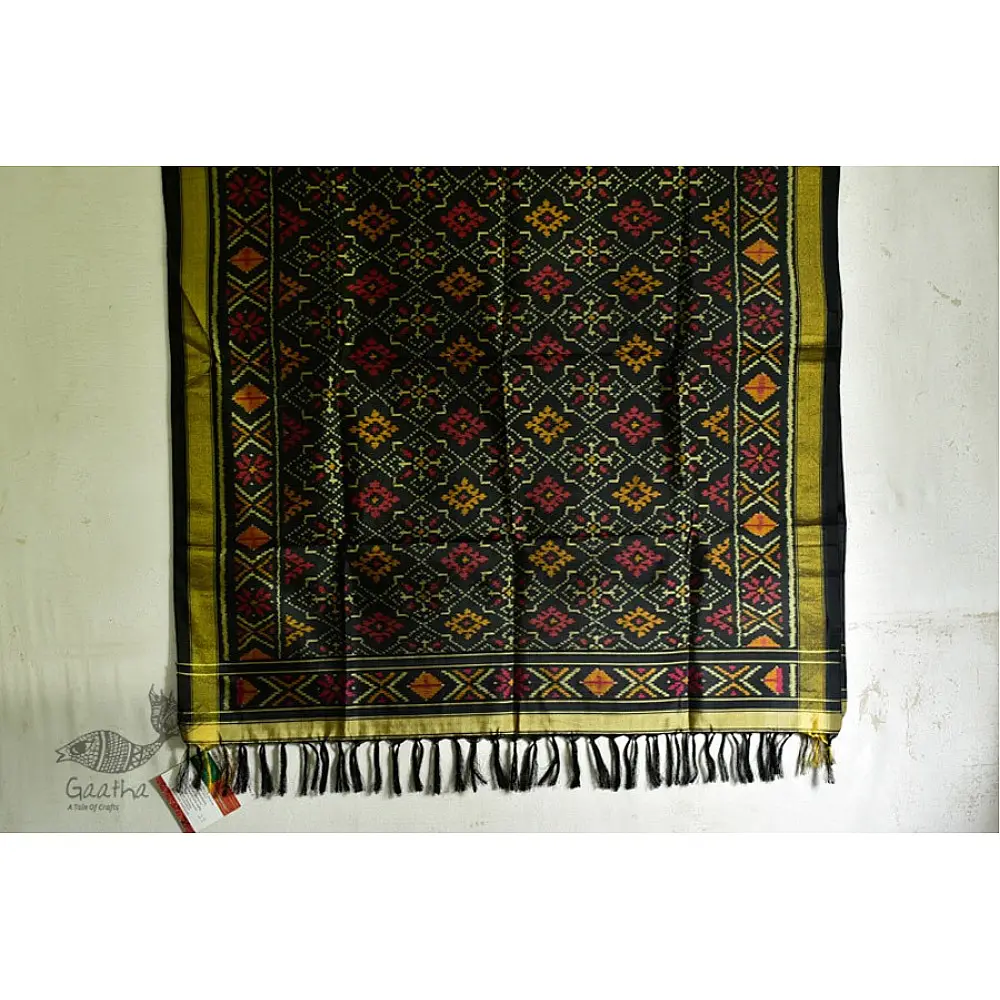
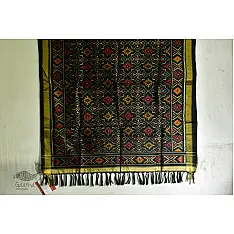
-1000x1000w.webp "buy online festive special rich patola silk dupatta - black")
-1000x1000h.webp "buy online festive special rich patola silk dupatta - black")
-1000x1000w.webp "buy online festive special rich patola silk dupatta - black")
-1000x1000w.webp "buy online festive special rich patola silk dupatta - black")


-80x80w.webp "buy online festive special rich patola silk dupatta - black")
-80x80h.webp "buy online festive special rich patola silk dupatta - black")
-80x80w.webp "buy online festive special rich patola silk dupatta - black")
-80x80w.webp "buy online festive special rich patola silk dupatta - black")
- Availability: 1
- Made & Mkt by: Saath
- Product Code: 2011-HC23-Black Diamond 003BS/009-03
- Weight: 400.00g
- Package Dimensions: 30.00cm x 20.00cm x 20.00cm

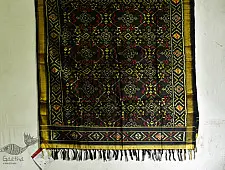
Man, an eternal traveler has traversed landscapes... on foot, on his rides, on flights in search of better lands, wealth and at times merely for wander lust... trading goods for necessity and pleasure on the way. One such route came to be known as the Silk Road, connecting the Far East to the West. Caravans passing through markets had men trading their wares, which at times also seconded as currencies. Among the usual grain, spices, slaves, silk and beasts the fabric of Ikat was first bartered as currency around 207 BCE to 220 CE.
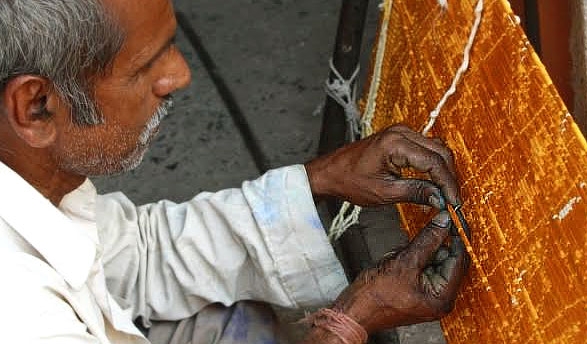
Ikat is a fabric with diverse histories owing to its multiple origins; however, the name is a Malay word literally for ‘to tie’. It is a weaving technique where in the weft, the warp or both the yarns are dyed selectively through a resist-dye process so that the patterns emerge upon the criss cross of the yarns.Patan, the former capital of Gujarat is the home for double Ikat, which incorporates a very high level of intricacy and skill. It starts with dyeing both the warp and the weft and matching them to form motifs at regular intervals. This requires pre calculation of where the dye should come on the yarn (warp or weft), for it to accurately form an overlap with the same or different colored stretch on the second yarn (weft or warp), to weave a majestic double Ikat fabric called Patola.
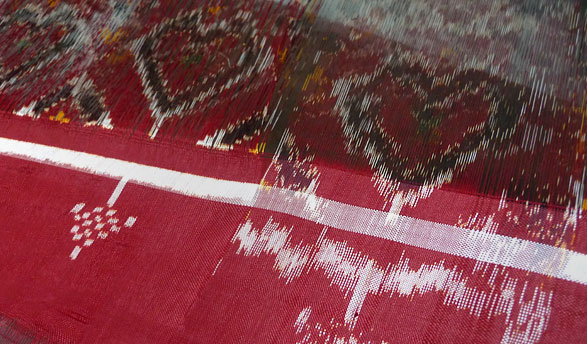
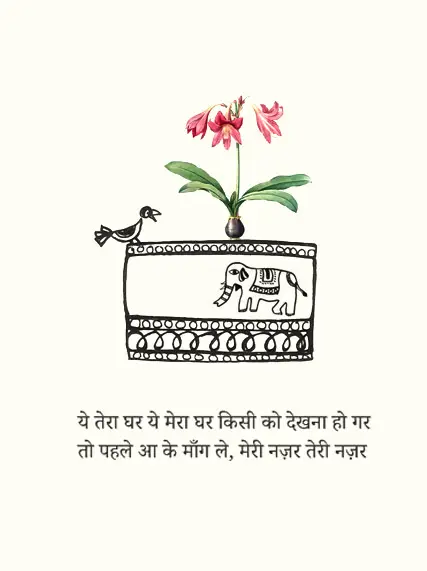
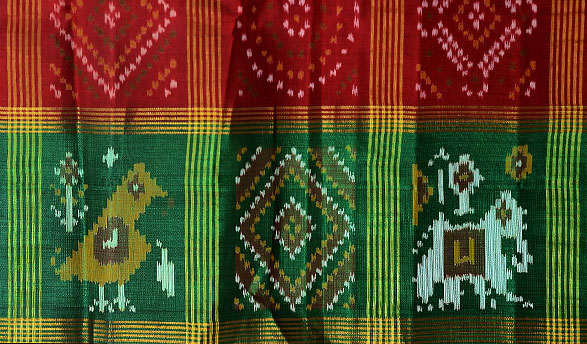
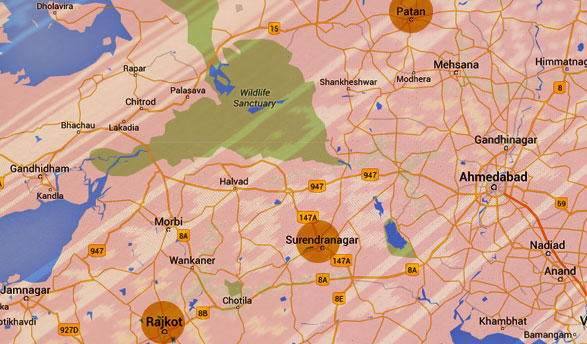
Considered to bring in luck and prosperity, a Patola Sari is often passed on as an heirloom or worn during baby showers. Both the sides of Patola sari display the same design. Each sari can survive over a century without losing its color and grandeur. On a Patola, the square represents security in every aspect of life. The elephant, parrot, peacock and kalash (metal pot) are considered saubhagya& (good luck). The demand for such an exquisite piece of hand woven textile is naturally much higher than what a handful of weavers in Patan can collectively create and those who can pay its price are also few in numbers. To cater to more lovers of Patola, a simpler version with similar visual effect but lesser intricacy and therefore lower price range was invented. The Single Ikat Patola of Surendranagar and neighboring villages came to the rescue of the weavers, the technique and the buyers in the region. About 70 years ago, Rashtriya Shala, a Gandhian institute in Rajkot organized a training camp and started special Patola unit to train weavers. Experts in Patan Patola provided intensive trainings.
A Gujarati folk song hums ‘padi patola bhat fatey pan fite nahi’ that speaks of the colourfastness of the natural dyes used in Patan Patola. Haldi, manjistha, ratanjyot, indigo, katha gave way to chemical dyes due to cost and efficiency concerns. It gears up the bleaching and dyeing process. The pure silk yarn accommodated cotton and rayon. The price plummeted as less as 1:100 due to which the Patola now found new takers; the middle and the lower middle class.
The migrant Vankar and the historical Maheshwari communities, now the native weavers of Rajkot and Surendranagar have mastered the technique of weaving musical compositions in cloth. The affair goes back to the times when elephants were the royal rides and their adornments were a serious affair of craftsmanship. Symmetry from leaves and flowers formed the understated classic human aesthetic. These characterize the Patola. Popat (parrot), Narikunj, Phulwadi, Chowkdi (cross), Chaabdi (Basket), Choktha, Navratna, Paanchphul, Sarvaiya, Laheriya are also the varied Bhats (patterns) one finds in the story that the Patola so intricately recounts. Traditional patterns have also seen a lot of tributaries of experimental patterns emerging out of them.
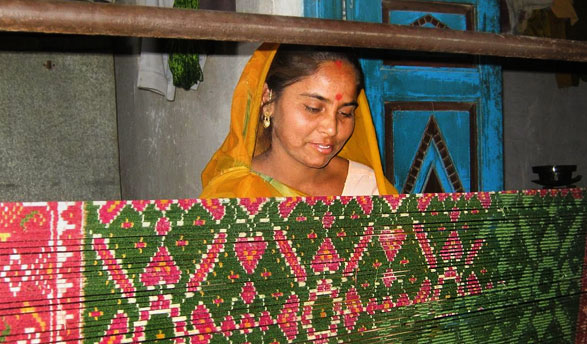
The single Ikat Patola sari has motifs, which are less densely woven as compared to the double Ikat Patola. The colors are different as well, with not more than three colors in a sari in varied shades. They also use zari, giving certain sheen to the sari, which also increases its price. The body of the sari is mostly plain with bold stripes of the same colour in different shades and borders lined with animal or plant motifs. The saris of a higher range have motifs on the body as well.
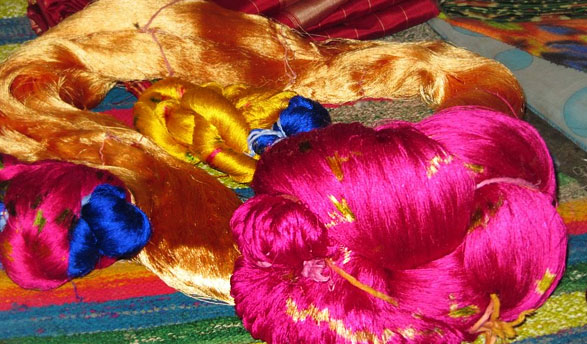
The preparation of Patola is an elaborate process. Following are the seven main steps of preparing a Patola:~Making silk pure. Cotton, rayon are directly sourced from the market.~Making the weft.~Making knots on the warp & weft as per the design. Tie-dyeing the knots on warp and weft.~Process of dyeing: The weft silk threads are tied separately with cotton thread on the portions already
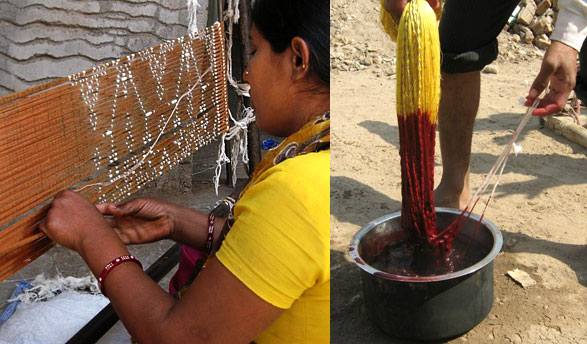
marked out in conformity with the proposed design in the fabric. This tied portion is meant to remain unexposed to the colour while dyeing. United portion, which has absorbed one colour, may be tied while dyeing in another colour. Tying untying, re-tying and dyeing in different shades are the main features of this process. After completion of dyeing work of wefts, the threads of the warp are put together in a sequence on the loom, so that the design becomes visible. The threads of wefts are wound on to bobbins and kept in the bamboo shuttle for weaving process.
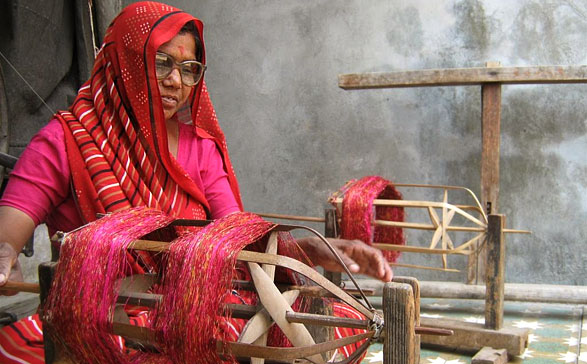
~Process of adjusting each threads of warp and weft: The tension of the warp threads is removed by the help of needle after every 8 to 10 inches are woven. Patola weaving is a highly accurate just a positioning of warp and weft of similar colour to obtain perfect design and harmony. The process is labour intensive, time consuming and requires high order of skill and dexterity.
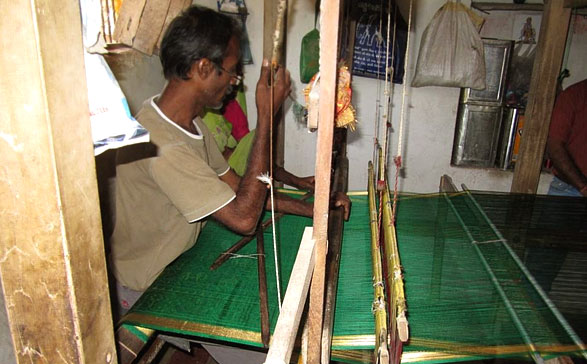
~Process of finishing the fabrics. It takes about 10-12 days to prepare tie- dyed design on warp and weft threads for a sari that is 6 yards in length and 48 inches wide. Two weavers working together weave just about 8 to 9 inches a day. It takes about 7 days to weave a complete sari.Technologies like Proweave, a digital drawing software have brought the pace and efficiency, characteristic of the modern world to this deeply traditional craft byhelping them print on paper the pixilated Ikat designs before transferring it on the loom.This craft faces the challenge of not extinction but the loss of originality in the process of fitting and existing in a world that is inclined towards standardization and consumerism. Only if the next time a weaver’s child would not have to hesitate in taking up the craft in lieu of acquiring a degree to get a job for aspirational or simply livelihood reasons would it stand a real chance of survival.
Related Products
-225x150w.webp "Kopal ❅ Handloom Linen - Embroidered Saree")
-225x150w.webp "Kopal ❅ Handloom Linen - Embroidered Saree")
-225x150w.webp "Kopal ❅ Handloom Linen Embroidered Saree - Sky Blue")
-225x150w.webp "Kopal ❅ Handloom Linen Embroidered Saree - Sky Blue")
-225x150w.webp "Kopal ❅ Handloom Linen Embroidered Saree - Light Green")
-225x150w.webp "Kopal ❅ Handloom Linen Embroidered Saree - Light Green")
-225x150w.webp "Kopal ❅ Handloom Linen Embroidered Saree - Light Yellow")
-1-225x150w.webp "Kopal ❅ Handloom Linen Embroidered Saree - Light Yellow")
-225x150w.webp "Kopal | Handmade ~ Kalamkari Silk Saree - Black & White")
-225x150w.webp "Kopal | Handmade ~ Kalamkari Silk Saree - Black & White")
-225x150w.webp "Kopal | Handmade ~ Kalamkari Silk Saree - Peacock & Peahen Pallu Motif")
-225x150w.webp "Kopal | Handmade ~ Kalamkari Silk Saree - Peacock & Peahen Pallu Motif")
-225x150w.webp "Kopal ❅ Handloom Linen Embroidered Saree - Light Orange")
-225x150w.webp "Kopal ❅ Handloom Linen Embroidered Saree - Light Orange")
-225x150w.webp "Handloom Cotton Saree | IKAT Pallu { Badami }")
-225x150w.webp "Handloom Cotton Saree | IKAT Pallu { Badami }")
-225x150w.webp "Handwoven Dhurrie | Cotton Mat / Aasan - Wave")
-225x150w.webp "Handmade Wooden Fridge Magnet (Set of Two) - Shiv Shakti")
-225x150w.webp "Colors of Devotion | Handwoven Maheshwari Plain Silk Saree")
-225x150w.webp "Colors of Devotion | Handwoven Maheshwari Plain Silk Saree")



-225x150w.webp "Ada . अदा | Ajrakh Bandhani Tussar Silk Stole - Black")
-225x150w.webp "Ada . अदा | Bandhani Tussar Silk Dupatta - Heart Design in Greenish Gray Colour")
-225x150w.webp "Ada . अदा | Bandhani Tussar Silk Stole - Grey")
-234x234.webp "Joon . जून ☽ Handloom Ajrakh Pure Cotton Yellow Saree")
-234x234.webp "Joon . जून ☽ Handloom Ajrakh Pure Cotton Yellow Saree")