
-1000x1000w.webp "buy Vintage Jewelry - Banjara Paysl / Anklet (Pair)")
-1000x1000w.webp "buy Vintage Jewelry - Banjara Paysl / Anklet (Pair)")
-1000x1000h.webp "buy Vintage Jewelry - Banjara Paysl / Anklet (Pair)")

-80x80w.webp "buy Vintage Jewelry - Banjara Paysl / Anklet (Pair)")
-80x80w.webp "buy Vintage Jewelry - Banjara Paysl / Anklet (Pair)")
-80x80h.webp "buy Vintage Jewelry - Banjara Paysl / Anklet (Pair)")
- Availability: Out Of Stock
- Made & Mkt by: A. Soni
- Product Code: 1616-WM23-71-4
- Weight: 600.00g
- Package Dimensions: 25.00cm x 20.00cm x 20.00cm
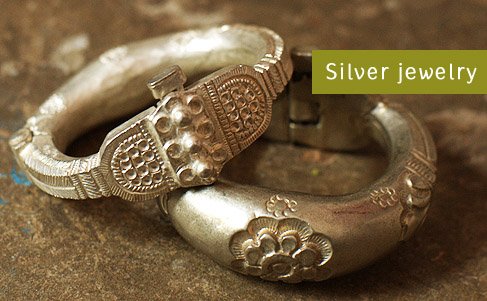
A tribal damsel dresses up for an occasion of surprise matrimony, barely being able to hold back the tide of thrill.Spring tickles my feet as love soaks this air,Is it a new reason to live, or just this excuse of the fair.I can wait to look my best, as I embrace the bridal flair.The brilliance of this silver competes with the spark that dwells in my stare.
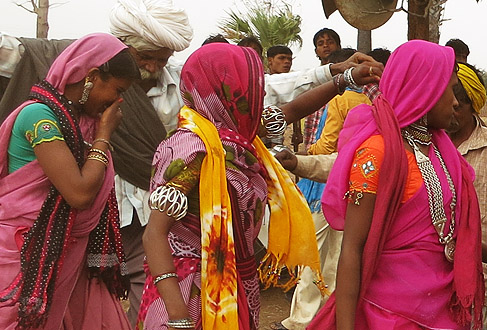
‘Bhagoria’ is a festival celebrated by the Bhils of Jhabua district in MP. Celebrated a week before Holi, it is an occasion were young unmarried men and women come exquisitely groomed in order to propose to their matrimonial preferences. And they have a very unique way of going about it, by applying ‘gulal’ (red holy powder) on the face of their beloved, in the presence of the entire village fraternity. If the latter is also mutually in love, the gesture is returned, followed by ceremonial act of eloping. Once the boy and girl are back from their romantic adventure, the elder folks gear up to get the young couple married.
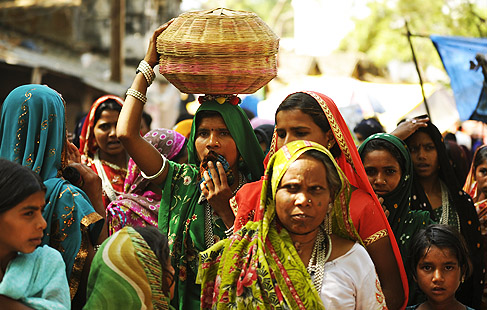
This queer fair sees men flaunting their charm as they reveal flirtatious melodies off their flute. The women on the other hand leave no stone, rather metal unturned, to ensure they are enrobed in jewelry and dressed to kill. Once the marriage is fixed, the girl escorted by womenfolk singing folk songs is taken to the silversmiths’, where she picks and chooses ornaments from a plethora of options. The singing and swaying women walk around the weekly fair, while the bride carries the stacked up jewelry in a basket on her head.
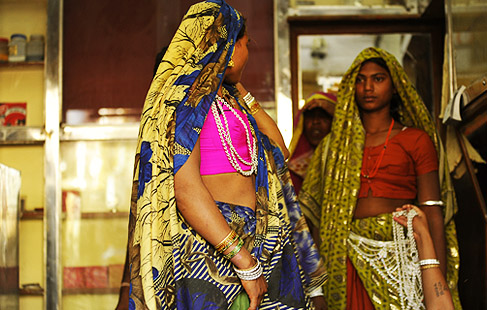
The most popular accessories amongst the women folk are the Basta Kada (armlet) ,Khilli wala kada (for the wrist) , Daal and kavali (bangles), Taagali (necklace),Paan wala haar (an ornament for the neck), Jhumki (earrings), finger rings in spiral forms and toe rings like Bichua, Angootha and kandora. It then does not come as a surprise that about four kilos of the Jhabua woman’s weight is what she calls her ritualistic grooming! It is interesting to note that the ‘Sigod wala haar’ (Image 2) is the ladie’s favourite, carrying two triangles joined by the beetle leaf motif at the center.
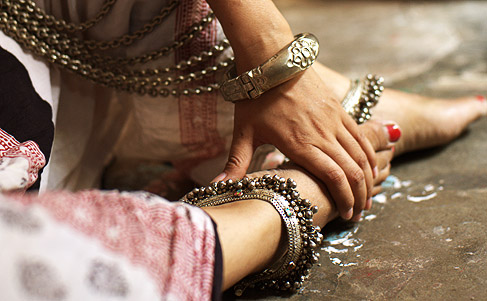
For a tribe as progressive as this, it is but essential that the men and women share equal privileges for everything, including the right to vanity. ‘Nhar mundya kada’ (or the tiger faced bracelet) is a preferred accessory amongst the local males.
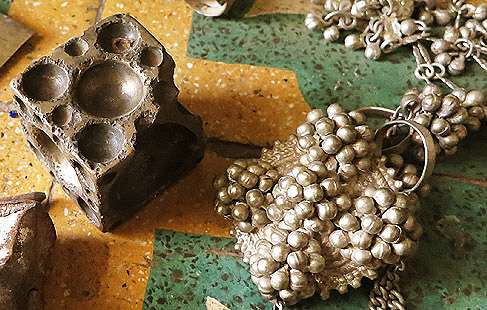
The materials required for this craft such as silver wires of varying thicknesses and the ‘ghunghroo’ (musical accessories comprising of metallic bells) are all sourced from the neighboring city of Indore. The iron dies which eventually get impregnated with molten silver, are bought from Udaipur. Lastly, silver is bought in the form of bricks or plates available locally.
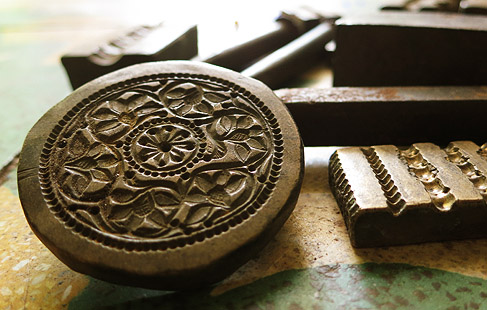
Most of the tribal jewelry can be made using the metal in two forms, as rods and as plates. For rods, the molten metal is poured into iron moulds with previously engraved motifs, while silver plates can be made by applying pressure on the solid section and are procured from the market. Consecutively, the rods are bent into closed curves to make armlets, bracelets and necklaces.
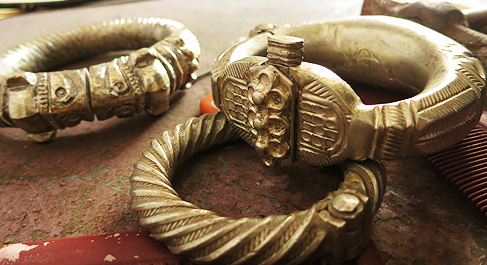
Chased faces of animals like elephant and tiger make the most popular endings for the rings. The plates are cut to get the desired outline of the pendant and impressions of the motifs are transferred onto them using hammers and dies. These pendants and ‘ghungroos’ are then attached to each other and to the main metal rod using linkages made of the wire. The process of finishing these ornaments brings out the real luster of the metal and is usually done with acid. The same ornaments are also made in white metal today.
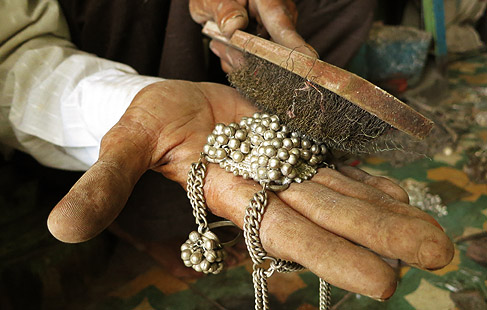
Having dedicated nearly four decades of his 51 year old life to the art of making silver jewelry, artisan Shri Rameshchandra Soni divulges that that the craft makes hay in the sunshine of the marriage season (from February to mid July). A chai-enthusiast otherwise, Soniji is happy to acknowledge that he has inherited all the treasured skills from his father.
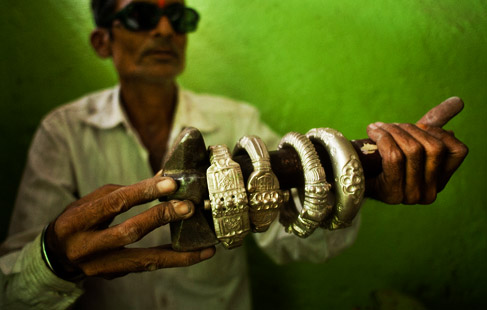
The fact that young lovebirds elope, as witnessing elders nod in consent to their romantic zeal, beats all standards of public display of affection and helps establishing Rumi’s belief that ‘ lovers don’t really meet at the fair, they were in each other all along’. Furthermore, a union of souls that concludes in a mutual desire to get married is the only little cultural idea that can beat our ever hyped nuptials today. There is indeed, much that these yet to civilize tribes can teach the new-age city dweller besides the art of jewelry making.
Related Products

-225x170h.webp "Kanupriya ~ Tribal / Vintage Necklace")
-225x170h.webp "Kanupriya ~ Tribal / Vintage Jewelry - Chandra Necklace")
-225x170h.webp "Kanupriya ~ Tribal / Vintage Jewelry - Jhumar Necklace")
-225x170h.webp "Kanupriya ~ Vintage Jewelry - Banjara Payal / Anklet (Pair) - B")

-225x150w.webp "Kusumaprabha . कुसुमांप्रभा ✦ Handcrafted Glass Earring - Polka Bug")
-225x150w.webp "Kusumaprabha . कुसुमांप्रभा ✦ Handcrafted Glass Earring - Polka Bug")
-225x150w.webp "Kusumaprabha . कुसुमांप्रभा ✦ Handcrafted Glass Earring - Lotus Bud")
-225x150w.webp "Kusumaprabha . कुसुमांप्रभा ✦ Handcrafted Glass Earring - Lotus Bud")
-225x150w.webp "Kusumaprabha . कुसुमांप्रभा ✦ Handmade Glass Earring - Fish")
-225x150w.webp "Kusumaprabha . कुसुमांप्रभा ✦ Handmade Glass Earring - Fish")
-225x150w.webp "Kusumaprabha . कुसुमांप्रभा ✦ Handcrafted Glass Earring - Frosted Glass Daisy")
-225x150w.webp "Kusumaprabha . कुसुमांप्रभा ✦ Handcrafted Glass Earring - Frosted Glass Daisy")
-225x150w.webp "Kusumaprabha . कुसुमांप्रभा ✦ Handcrafted Glass Earring - Amber Yellow Flame Bloom")
-225x150w.webp "Kusumaprabha . कुसुमांप्रभा ✦ Handcrafted Glass Earring - Amber Yellow Flame Bloom")
-225x150w.webp "Kusumaprabha . कुसुमांप्रभा ✦ Handmade Glass Pale Pink Moth Earring")
-225x150w.webp "Kusumaprabha . कुसुमांप्रभा ✦ Handmade Glass Pale Pink Moth Earring")
-225x150w.webp "Kusumaprabha . कुसुमांप्रभा ✦ Handmade Glass Earring - Shiuli Flower")
-225x150w.webp "Kusumaprabha . कुसुमांप्रभा ✦ Handmade Glass Earring - Shiuli Flower")
-225x150w.webp "Surajmukhi Wood Carving ~ Walnut Wood Box")

-225x150w.webp "Damodar . दामोदर ✹ Handloom Matka Silk + Matka Silk Dhoti & Khes - Red & Silver Line Border")



-225x150w.webp "Ada . अदा | Ajrakh Bandhani Tussar Silk Stole - Black")
-225x150w.webp "Ada . अदा | Bandhani Tussar Silk Dupatta - Heart Design in Greenish Gray Colour")
-225x150w.webp "Ada . अदा | Bandhani Tussar Silk Stole - Grey")

-234x234w.webp "Kanupriya ~ Vintage Jewelry - Banjara Payal / Anklet (Pair) - D")