
-1000x1000h.webp "buy tangaliya cotton stole")
-1000x1000h.webp "buy tangaliya cotton stole")
-1000x1000w.webp "buy tangaliya cotton stole")
-1000x1000w.webp "buy tangaliya cotton stole")
-1000x1000w.webp "buy tangaliya cotton stole")

-80x80h.webp "buy tangaliya cotton stole")
-80x80h.webp "buy tangaliya cotton stole")
-80x80w.webp "buy tangaliya cotton stole")
-80x80w.webp "buy tangaliya cotton stole")
-80x80w.webp "buy tangaliya cotton stole")
- Availability: Out Of Stock
- Made & Mkt by: Saath
- Product Code: 2011-SD22-Purple A004C/006-26
- Weight: 500.00g
- Package Dimensions: 20.00cm x 20.00cm x 25.00cm

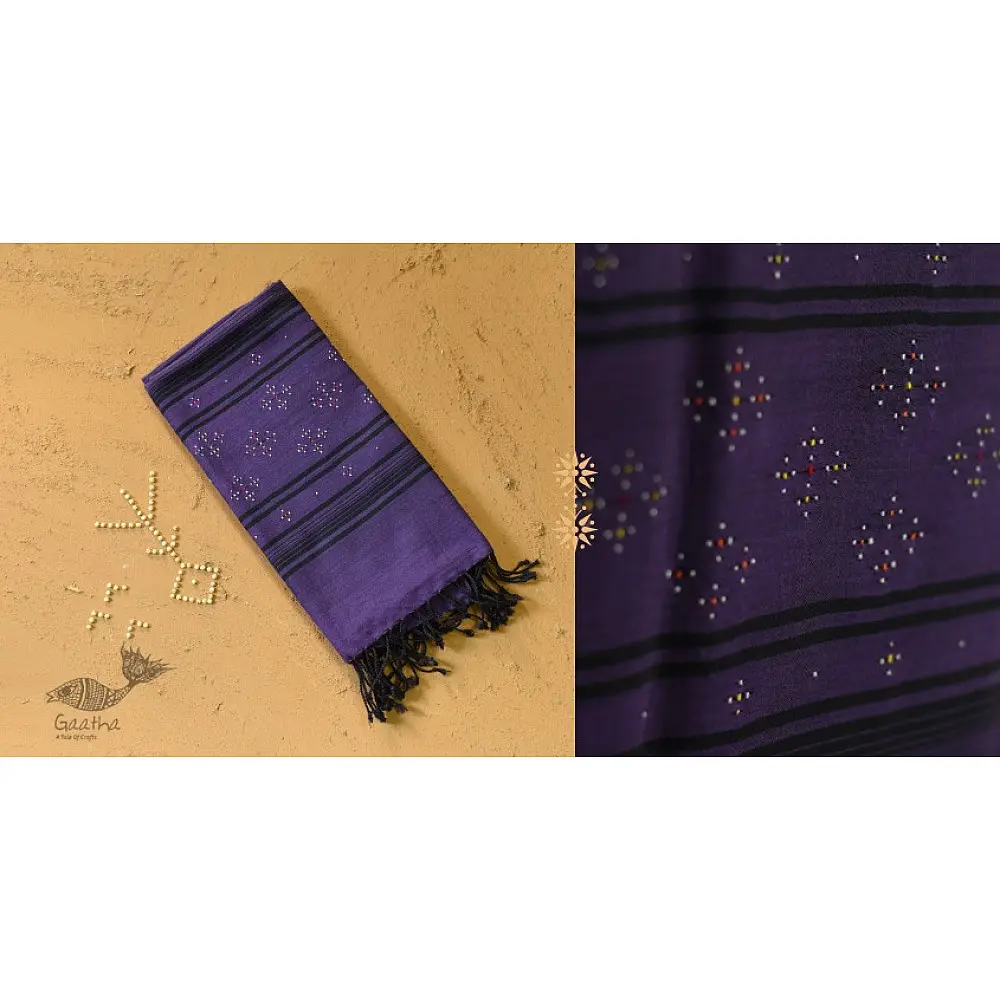
Legend tells us that, centuries ago, in the stark landscape of Saurashtra, a shepherd man married a woman from the weaver community amidst great opposition from both sides. He went to live among the weavers. Here he continued to graze his sheep but also learnt the art of weaving. Thus, wool began to be woven in the area and the craft of Tangaliya was born. The marriage influenced the rich tapestry of Indian craft forever. Children born to them were known as Dangasia, born of shepherds and weavers, and they continue to remain the sole practitioners of Tangaliya weaving till date.

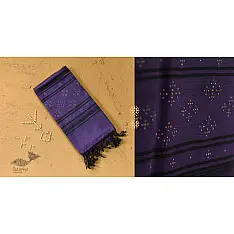
It is 700 years old hand weaving technique, which derives its name from Tang, meaning leg. The textile is a part of the traditional costume of the Bharwad (the shepherd community) of Gujarat. Women of the Bharwad community are often seen wearing dotted wrapped skirts in black with contrasting woven dotted forms as embellishments. This unique form of weaving with its dotted splendor is practiced in Surendranagar district of Gujarat.

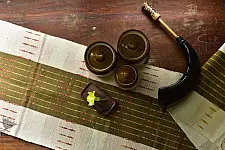
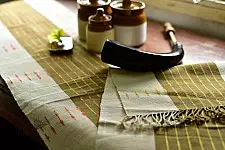
Tangaliya is a labor-intensive and painstaking process. Gheta (native sheep) wool forms the raw material for weaving of base fabric on which a special technique called beadwork or dana-work is done. A dana is formed on the weft yarn, through the process of tying together a minimum of three warps by wrapping a contrasting colored fine cotton thread around them. The weavers’ fingers sense exactly the right number of warp threads and twist extra weft around them.

Through this, motifs are woven into the fabric while it is still on the loom. This results in a glorious geometric pattern, tiny white dots lighting up rich, dark fabrics giving the effect of fine embroidery to it. Traditionally, Tangaliya used black sheep or camel wool to create shawls and blankets (Dhablas) for the shepherds, but now they weave magic with cotton and silk also for the contemporary market.

History reveals that they also used fibers of trees before they started growing and using cotton. With time they improvised their weaving technique and adopted Amar Charkha introduced by the Father of our nation, Gandhi ji, to weave fine cotton. They strived for different techniques & introduced a pit loom. A pit is dug and wooden loom is installed on it. Pit is usually for the weaver to sit in for the loom to reach the height of his lap. The frame of the loom consisted of six horizontal wooden logs & ten vertical logs. Such loom could be installed anywhere. The fabric woven on a pit loom is usually 2 feet in width and made 20 feet long. Two pieces each of 10 feet obtained by cutting the length into half are stitched together. The intricate method of twisting the extra weft while weaving creates beautiful linear patterns.

GI (Geographical Indication) status for the Artisans of Tangaliya of Surendranagar in order to protect and promote the interests of the artisans has been obtained in the year 2008.

Problems faced by weavers are lack of demand of the product owing to lack of exposure. They get alternative employment with better remuneration in agriculture and they leave their craft. The weavers who get bonus by Khadi Board are the only ones who want to work. They are not taught new techniques & designs. They put in more number of hours for very meager wages. Expensive raw material is another occupational hazard. Loans for raw material at reasonable interests and assurance of salability of their produce will help them survive.
Related Products
-225x170w.webp "Gulmohar . गुलमोहर | Tangaliya Woven Cotton Stole - Peach")
-225x170w.webp "Gulmohar . गुलमोहर | Tangaliya Woven Cotton Stole - Black")
-225x150w.webp "Ishana . इशाना ✯ German Silver Dual-Line Textured Bead Choker Necklace:")
-225x150w.webp "Ishana . इशाना ✯ German Silver Dual-Line Textured Bead Choker Necklace:")
-225x150w.webp "Ishana . इशाना ✯ German Silver Pinecone Motif Hasli Choker Necklace - B")
-225x150w.webp "Ishana . इशाना ✯ German Silver Pinecone Motif Hasli Choker Necklace - B")
-225x150w.webp "Ishana . इशाना ✯ German Silver Triangular Spike Choker Necklace: - A")
-225x150w.webp "Ishana . इशाना ✯ German Silver Triangular Spike Choker Necklace: - A")
-225x150w.webp "Ishana . इशाना ✯ German Silver Lotus Motif Earring")
-225x150w.webp "Ishana . इशाना ✯ German Silver Lotus Motif Earring")
-225x150w.webp "Ishana . इशाना ✯ German Silver Earring - Elephant Motif")
-225x150w.webp "Ishana . इशाना ✯ German Silver Earring - Elephant Motif")
-225x150w.webp "Ishana . इशाना ✯ German Silver Earring - B")
-225x150w.webp "Ishana . इशाना ✯ German Silver Earring - B")
-225x150w.webp "Ishana . इशाना ✯ German Silver Earring - A")
-225x150w.webp "Ishana . इशाना ✯ German Silver Earring - A")


-225x150w.webp "Rasika . रसिका ♡ Handwoven Patola Silk Cotton Black Dupatta")
-225x150w.webp "Rasika . रसिका ♡ Handwoven Patola Silk Cotton Black Dupatta")
-225x150w.webp "Vasant . वसंत ~ Woolen Patola Shawl ~ Blue Traditional")
-225x150w.webp "Vasant . वसंत ~ Woolen Patola Shawl ~ Blue Traditional")



-225x150w.webp "Ada . अदा | Ajrakh Bandhani Tussar Silk Stole - Black")
-225x150w.webp "Ada . अदा | Bandhani Tussar Silk Dupatta - Heart Design in Greenish Gray Colour")
-225x150w.webp "Ada . अदा | Bandhani Tussar Silk Stole - Grey")
-234x234h.webp "Gulmohar . गुलमोहर | Tangaliya ⁂ Cotton Stole - Purple")