In Maharashtra, crafts are closely connected to Maratha pride and cultural identity. The region’s notable traditions include Warli painting, Paithani weaving, Bidri work, and Kolhapuri leather craft. Across these forms, artisans have explored diverse materials and techniques while maintaining a deep connection to local knowledge, resources, and heritage.
Compared with some other states, Maharashtra today appears to have a smaller number of active craft clusters and traditional craftsmen. One possible reason is the state’s early industrial development, which encouraged many communities to shift to other occupations over time.
However, crafts continue to hold an important place in Maharashtra’s cultural life. Many traditions remain closely linked to festivals, rituals, and everyday practices. Alongside crafts, other cultural expressions such as theatre and performance traditions have also played a significant role in shaping the region’s artistic landscape, reflecting the dynamic and evolving nature of Maharashtra’s cultural heritage. Here is a list of the 10 most iconic arts and crafts of Maharashtra.
1. Paithani Saree
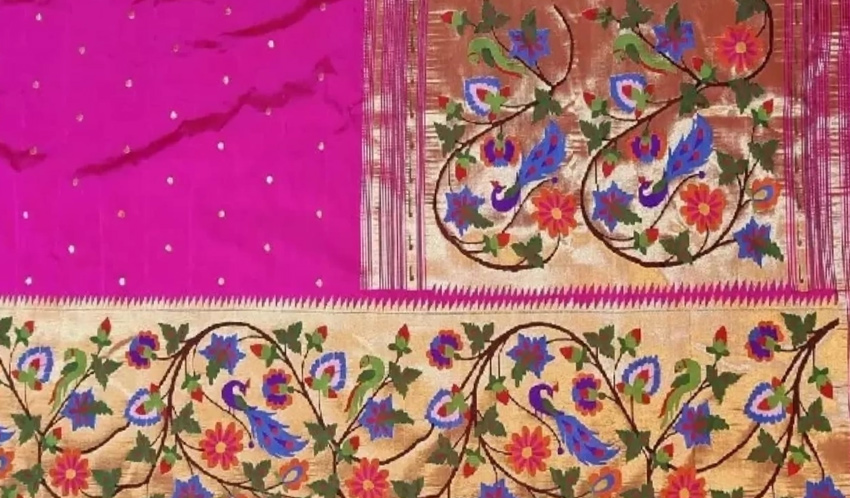
Paithani saree are one of India’s oldest and most luxurious handwoven textiles, originating from Paithan on the banks of Godavari river in Maharashtra. Each saree is entirely handwoven on a loom, without mechanical assistance, making the process slow and highly skilled. Weaving a single Paithani can take several months, reflecting patience, precision, and mastery. The saree is crafted using pure silk yarn and hand-drawn zari, giving it unmatched sheen and durability. Paithani weaving follows the tapestry technique, where motifs are individually interlocked by hand. Artisans from Paithan and Yeola spend months creating a single saree, often working without written patterns. Designs such as mor (peacock), kamal (lotus), bangdi mor, and narali borders hold cultural symbolism. Traditionally, vegetable dyes were used to achieve deep hues like magenta, peacock blue, and golden yellow. Every Paithani is unique, as no two weavers interpret motifs exactly the same way. A true Paithani features a tapestry-style pallu, where both sides of the design look identical. The craft sustains local weaving communities and preserves Maharashtra’s cultural identity. Paithani saree received the Geographical Indication (GI) tag in 2010. This recognition helps protect the craft from imitation and safeguards the livelihood of its artisans.
2. Warli Painting
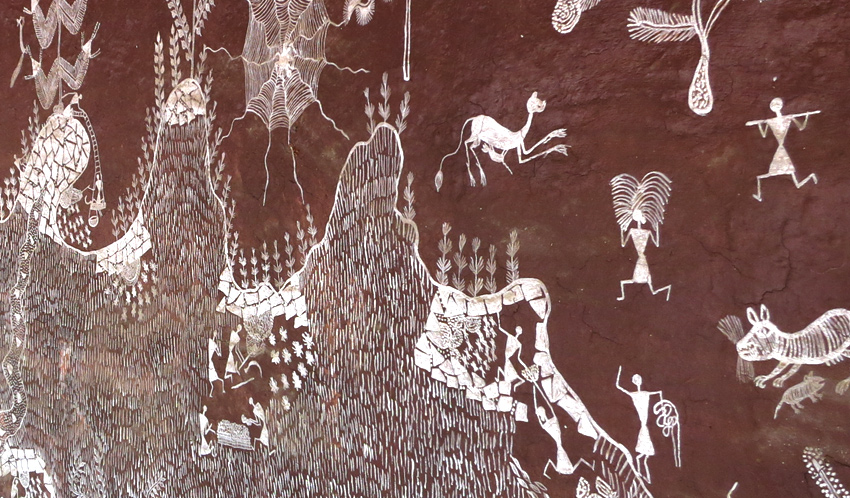
Warli painting is an ancient tribal art form practiced by the Warli community of Maharashtra. It originated in the Sahyadri ranges, particularly in Palghar, Thane, and Nashik districts. The roots of Warli art can be traced back over 2,000 years, reflecting early human expression. Natural materials like rice paste and water were used to create the white pigment. Traditionally, these paintings were created on mud walls during harvests and weddings. Artisans narrate stories of farming, festivals, animals, and community life through these forms. The central motif, the Tarpa dance, celebrates rhythm, unity, and social harmony. This art form embodies the Warli tribe’s deep respect for nature and coexistence. Warli painting received the Geographical Indication (GI) tag in 2011. Each Warli artwork stands as a timeless reminder that art can be simple, sacred, and deeply human.
3. Ghongadi
Ghongdi is a traditional handwoven woollen blanket from Maharashtra, deeply rooted in rural life. The craft is closely associated with the Dhangar and other pastoral groups. Made from locally sourced sheep wool, Ghongdi reflects sustainable and climate-responsive design and is valued for its warmth, durability, and versatility. The wool is cleaned, spun, and woven using simple handlooms. Natural colours of black, grey, and off-white are traditionally retained. It is used as bedding, clothing, and protective gear during harsh winters. Artisans from Solapur, Ahmednagar, Satara, and parts of Marathwada keep this craft alive. The craft relies on collective community labour and inherited knowledge. Despite its utility, Ghongdi carries strong cultural and emotional significance. Ghongdi received the Geographical Indication (GI) tag in 2016. More than a blanket, Ghongdi is a symbol of resilience, self-reliance, and rural wisdom.
4. Sawantwadi Wooden Toys
Sawantwadi wooden toys are a vibrant traditional craft from Sindhudurg district in Maharashtra. The craft dates back to the 17th century, flourishing under the patronage of the Sawant Bhonsle royal family. Originally created as royal gifts, these toys later became part of everyday cultural life. Artisans hand-carve, assemble, and polish each piece using traditional tools. Natural lac and vegetable dyes are used to achieve bright, glossy colours. The toys often depict animals, fruits, household objects, and traditional games. Generations of artisan families in Sawantwadi continue to preserve this knowledge. The craft reflects Konkan’s folk aesthetics and sustainable practices. Sawantwadi wooden toys received the Geographical Indication (GI) tag in 2017. The GI tag protects a joyful legacy shaped by royal history and artisan hands. Learn more at gaatha research and archive.
5. Solapuri Chaddar
Solapuri chaddar is a traditional handwoven cotton textile from Solapur, Maharashtra. The region became a textile hub during the British period due to its dry climate and cotton availability. Over time, local weavers adapted mill yarns for handloom weaving. The chaddar is known for its lightweight texture and is woven using cotton yarn on handlooms and power looms. Cotton yarn makes it suitable for both warm and dry climates. The chaddar is traditionally woven with bold stripes and geometric layouts. Solapuri chaddars are used as blankets, bedsheets, shawls, and everyday coverings. They are known for their absorbency, breathability, and long-lasting quality. Solapuri chaddars are traditionally woven by Padmashali (Padma Sali) weavers. Solapuri chaddar was awarded the Geographical Indication (GI) tag in 2006. A simple textile, it carries the weight of labour, livelihood, and local legacy.
6. Himroo Shawl
Himroo shawls are a luxurious woven textile tradition from Aurangabad, Maharashtra. The craft evolved during the medieval period under the influence of Persian aesthetics. Himroo is believed to have developed as a more accessible alternative to costly brocades. It flourished under the patronage of the Deccan Sultanates and later the Mughals. The textile is woven using a blend of silk and cotton, giving it softness and strength. Artisans use extra-weft techniques to create intricate floral and geometric patterns. Traditional motifs reflect Persian gardens, vines, and architectural forms. Weaving Himroo requires high skill and precision, often taking weeks to complete a piece. The weaving tradition is preserved within artisan families of Aurangabad. Patterns are often memorised rather than written, passed orally through generations. Himroo weaving supports artisan families primarily in and around Aurangabad. Himroo shawls received the Geographical Indication (GI) tag in 2008. Each Himroo piece carries echoes of royal courts, cultural exchange, and artisan mastery.
7. Kolhapuri Chappal
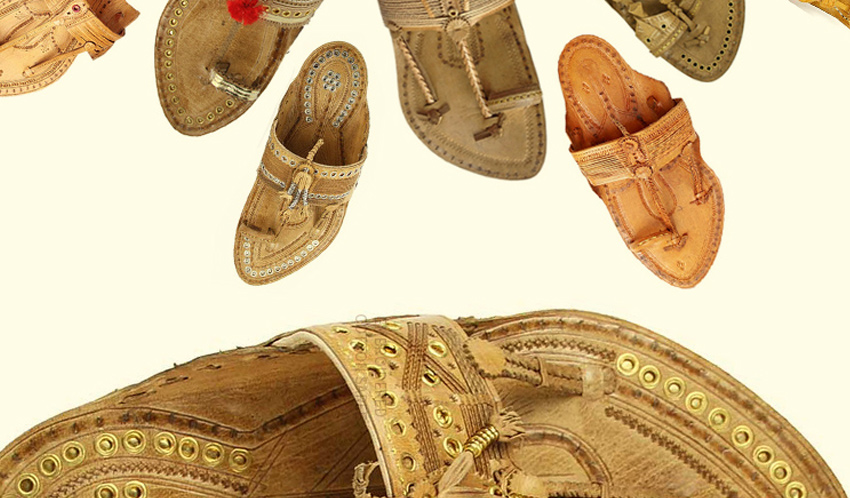
Kolhapuri chappals are iconic handcrafted leather footwear originating from Kolhapur in Maharashtra. Their history dates back to the 12th century, when they were worn by local rulers, warriors, and rural communities. Traditionally known as Kapashi, Paytaan, Bakkalnali, and Pukri, each style reflects regional identity. Each chappal is made from locally sourced, vegetable-tanned leather processed using traditional methods. Every pair is hand-cut, hand stitched, and shaped for durability and comfort. Distinct braided straps and toe loops define the classic Kolhapuri silhouette. Natural oils are used to finish the leather, allowing it to age beautifully over time. Artisans from Kolhapur, Sangli, Satara, and Solapur form the backbone of this craft tradition. The craft supports thousands of rural artisan families across Maharashtra. The craft supports thousands of rural artisan families across Maharashtra. Kolhapuri chappals were granted the Geographical Indication(GI) tag in 2019, recognising their regional uniqueness. Every Kolhapuri chappal carries the imprint of history, handcraft, and human touch.
8. Karvati Kinaar Saree
Karvati (saw tooth) Kinaar (border) sarees are handwoven using the three-shuttle technique in the weaving cluster of Vidarbha, Bhandara district of Maharashtra. The serrated border resembles the teeth of a carpenter’s saw also known as Karvat in Marathi. Karvati sarees are typically woven in silk or silk–cotton blends. The body is usually simple, allowing the border to stand out prominently. Traditional colours include deep reds, greens, purples, and indigo tones. The saree reflects regional aesthetic preferences for geometric detailing. Weaving is carried out on handlooms using traditional techniques. The craft is associated with hereditary weaving communities in Maharashtra. Defined by its striking serrated border, the Karvati saree embodies subtle geometry within Maharashtrian textile heritage.
9. Puneri Pagdi
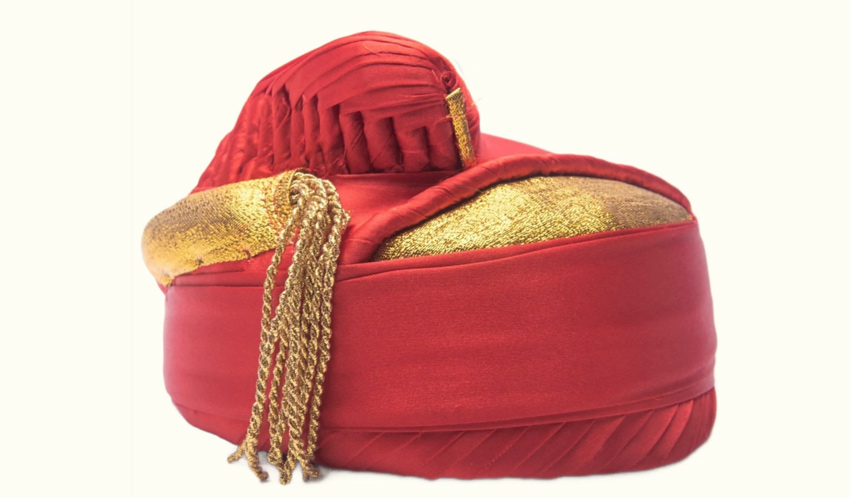
Puneri Pagdi is a traditional turban associated with Pune, Maharashtra. It emerged prominently during the Peshwa period in the 18th century. The pagdi became a symbol of honour, discipline, and social status. It was traditionally worn by scholars, administrators, and community leaders. The pagdi reflects Pune’s reputation for restraint and formality. It is commonly worn during cultural events, weddings, and official ceremonies. It is made from finely woven cotton fabric, carefully folded and stitched into shape. Unlike many turbans that are tied each time, the Puneri Pagdi is pre-stitched. Its distinctive shape includes a flat top and structured sides. Artisans specialising in pagdi-making preserve this niche craft. Puneri Pagdi received the Geographical Indication (GI) tag in 2009. It remains a lasting emblem of Pune’s identity and cultural pride.
10. Miraj Musical Instruments
Miraj, in Sangli district of Maharashtra, is renowned for its handcrafted string musical instruments. The craft gained prominence in the late 19th and early 20th centuries. It flourished under royal patronage from the princely state of Miraj. Miraj is especially known for making sitar, tanpura, sarod, and tambura. The instruments are crafted from seasoned teak wood and specially selected gourds. Artisans carve, hollow, assemble, and polish each instrument by hand. Precision in shaping and tuning is critical for acoustic quality. The craft is traditionally practiced by Muslim artisan families in Miraj. Skills are passed down through apprenticeship within family workshops. Miraj instruments are widely used in Hindustani classical music. Miraj Sitar and Tanpura received the Geographical Indication (GI) tag in 2014. Miraj remains a vital centre where craftsmanship and classical music tradition intersect
Leave a Comment