




A new home is not simply a space to fill. It is the beginning of a family's visual vocabulary, the accumulation of objects that will form the backdrop of every conversation, every meal, every season that passes through those rooms. The gifts that last are rarely the most expensive ones. They are the ones that have a reason for being what they are: an origin, a technique, a maker, a tradition that gives the object weight beyond its material.
India's craft traditions offer something that very few other gift categories can match: objects that are genuinely unrepeatable, made by communities who have spent generations perfecting a single process, using materials and methods that carry four thousand years of continuous use. Giving one of these to a new home is not just a gesture of celebration. It is the beginning of a conversation between the object and the space — one that deepens the longer they coexist.
At Gaatha, we have spent years in the field with the artisan communities behind these crafts, documenting the techniques, the families, the villages, and the histories. What follows is not a product list. It is a guide to ten objects that earn their place in a new home and hold it for decades.
1. DHOKRA BRASS SCULPTURE
Dhokra is made by a technique that has not changed in four thousand five hundred years. Archaeological evidence from Mohenjo-Daro confirms that the lost-wax casting method used by Dhokra artisans today — in which beeswax is formed over a clay core, covered in clay, fired until the wax melts away, and then filled with molten brass — was already in use when the Indus Valley civilisation was at its height. The clay mould is broken to release the finished piece. This means every Dhokra sculpture is a single casting, and no two are ever identical.
The rough, slightly pitted surface of a Dhokra piece is the record of the wax that preceded it. Over time the brass develops a patina — darker in the recesses, warmer on the high points — that makes the sculpture look more considered with age, not less. For an entrance shelf, a living room table, or a study corner, a Dhokra horse, elephant, or tree-of-life panel provides a quality that nothing mass-produced can approach: physical evidence of a human hand and a process that has been practised, without interruption, longer than most civilisations have existed.
Price range: ₹1,200 – ₹8,000 | Explore Dhokra on Gaatha →
2. PICHWAI PAINTING
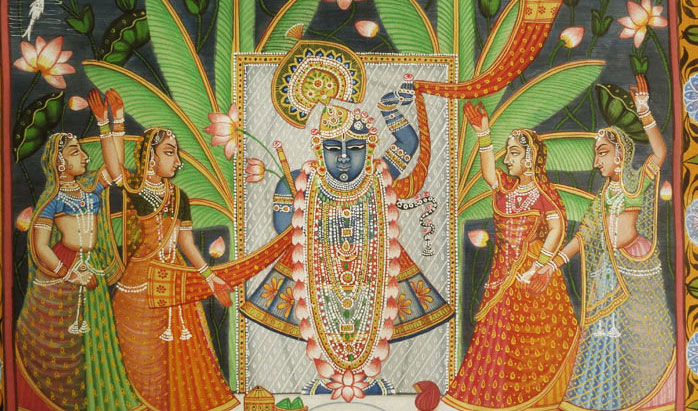
The word Pichwai comes from the Sanskrit pichh, meaning back, and vai, meaning hanging — a cloth hung behind the deity. In the Nathdwara temple of Rajasthan, Pichwai paintings were created specifically to hang behind the idol of Shrinathji, changing daily to reflect the ritual calendar: lotus ponds in autumn, lamps at Diwali, rain-dark skies in the monsoon. The hereditary painter families of Nathdwara — whose relationship with this tradition stretches back to the seventeenth century — still make Pichwai using natural mineral pigments on cloth or handmade paper.
For a new home, Pichwai is among the most contextually rich gifts possible. The lotus, which appears in most Pichwai compositions as the central motif of Lakshmi, carries an explicit association with abundance and new beginnings — a symbolism entirely appropriate to Griha Pravesh. The palette of deep blues, layered golds, and warm ochres is genuinely neutral in the design sense: it works with traditional interiors and contemporary ones equally. A mid-sized framed Pichwai does not merely decorate a wall. It establishes one.
Price range: ₹2,000 – ₹15,000 | Explore Pichwai on Gaatha →
3. MADHUBANI PAINTING ON HANDMADE PAPER
Madhubani painting comes from Bihar's Mithila region, where women of the community have long painted walls and floors for every significant domestic occasion — births, marriages, festivals, and the movement of seasons. The visual language is not decorative in the conventional sense. Every symbol carries meaning. The fish represents fertility and auspiciousness. The sun and moon depicted together signify eternity. The peacock, which appears constantly across the tradition, brings beauty and abundance. The borders of a Madhubani painting are always filled completely — to leave blank space is considered inauspicious in the Mithila tradition.
Authentic Madhubani is made on handmade paper — you can feel the fibrous, slightly irregular texture on both sides — using natural dyes derived from turmeric, indigo, pomegranate rind, and flower extracts. As a housewarming gift it carries an unusual quality: the longer the recipient spends with it, the more they discover within it. A painting that seemed to be simply a tree reveals itself, over months, to be a cosmology. This is a gift that gives in layers, over years.
Price range: ₹500 – ₹6,000 | Explore Madhubani on Gaatha →
4. KAAVAD WOODEN STORYTELLING SHRINE
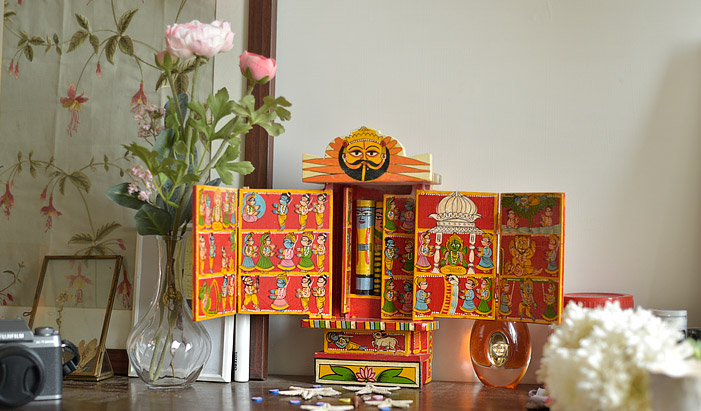
The Kaavad is made by the Suthar carpenter community of Bassi, near Chittorgarh in Rajasthan, and is unlike any other craft object in India. It is a portable wooden shrine whose hinged panels open one by one, each revealing a scene from the Ramayana, the Mahabharata, or a local folk epic. Traditionally, it was carried door-to-door by Kaavadiya Bhats — itinerant storytellers who used the shrine as their stage, narrating each panel in sequence until the final revelation: the deity, waiting at the innermost panel, visible only after the full journey through the narrative. To receive a Kaavad is to receive a storyteller's entire repertoire in a single object.
For a home occupied by someone who values stories — books on shelves, prints that mean something, objects with a reason for their existence — the Kaavad is the most distinctive housewarming gift on this list. It functions simultaneously as devotional object, sculpture, and conversation piece. It has a place in a puja corner, on a living room shelf, or on a study desk. Every person who encounters it will ask what it is. The answer never gets shorter, and that is entirely the point.
Price range: ₹1,500 – ₹8,000 | Explore Kaavad on Gaatha →
5. HANDMADE BEAD TORAN
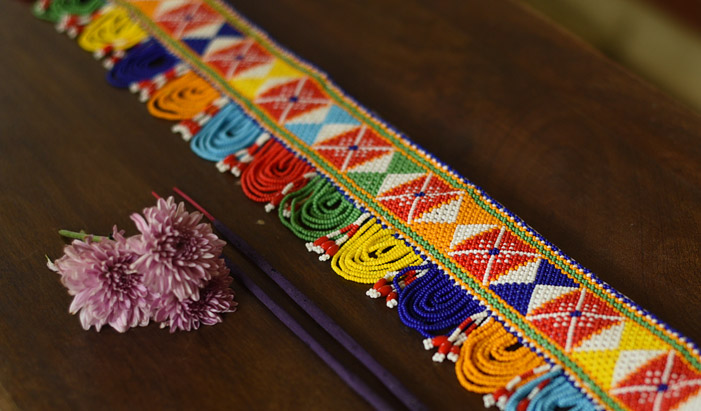
A toran is a door hanging, and hanging one at the entrance of a new home is among the oldest and most consistent gestures of Griha Pravesh across India's regional traditions. The form varies by community — mango leaves and marigolds in their most ephemeral version, cloth and silk in their festive form — but the handmade bead torans of Gujarat and Rajasthan are the enduring, artisan-made version: worked in glass beads, mirror-work (the Kutchi technique of abhla bharat), and hand-knotted thread on a fabric backing, designed to be hung not for a day but for years.
A handmade bead toran is the most contextually direct gift on this list. It belongs at the main door or at the entrance of the pooja ghar, it is hung on the first day, and it stays. The craftsmanship in a good Kutchi mirror-work toran rewards close attention: tiny mirrors that catch every shift of light, small bells that respond to movement, hand-knotted thread that holds the whole composition with the density of embroidery. This is an object whose reason for being is entirely specific to the moment of a new home, and that specificity is exactly what makes it the right gift.
Price range: ₹400 – ₹2,500 | Explore Toran on Gaatha →
6. BIDRIWARE DECORATIVE BOX OR VASE
Bidriware is made in Bidar, Karnataka, by an alloy of zinc and copper inlaid with silver wire that has been hammered into carved grooves, then treated with a paste made from Bidar's local soil — a soil whose specific mineral composition permanently blackens the alloy, leaving only the silver gleaming against a matte black ground. The technique was brought to Bidar by Persian craftsmen under the Bahmani Sultanate in the fourteenth century, and it holds a GI (Geographical Indication) tag. The blackening treatment works only with Bidar's particular soil. The same technique, performed anywhere else, produces a different result.
Bidriware is one of the most visually direct objects in India's craft catalogue — the silver-on-black contrast reads clearly in any light, at any distance. A Bidriware box on a bookshelf or a Bidriware vase on a side table requires no context to be understood as significant. It was historically a diplomatic gift between Mughal courts, given when the intention was to communicate cultural weight alongside the gesture. For a recipient who has everything, or for whom the object's history matters as much as its appearance, Bidriware carries that weight naturally.
Price range: ₹1,500 – ₹9,000 | Explore Bidriware on Gaatha →
Every piece in Gaatha's collection comes with the story behind it — the artisan family, the village, the technique. When you give from Gaatha, the story travels with the object. Browse the full collection at shop.gaatha.com →
7. WOODEN MASK OR CHHAU DANCE MASK
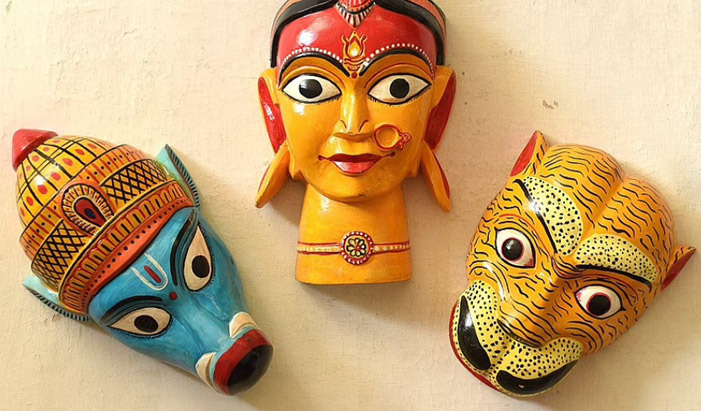
Chhau is a semi-classical martial dance performed in the tribal belt of Jharkhand, West Bengal, and Odisha, and its masks are among the most expressive objects in India's performing arts traditions. The Purulia Chhau masks of West Bengal are made from clay, paper pulp, cloth strips, and natural pigments by hereditary mask-making communities. They depict gods, demons, animals, and cosmic figures from the Ramayana and Mahabharata — faces built for performance, designed to read at a distance, to carry character through an entire dance sequence without the subtlety of facial expression to assist them. This is why, on a wall, they work so immediately.
A Chhau mask or a carved wooden tribal mask from Odisha, Rajasthan, or Tamil Nadu is one of the most practical gifts on this list in the specific sense that it requires almost nothing of the recipient: one nail, any wall. The scale, colour, and character of these masks give a room an identity that takes most homeowners months and many purchases to achieve through other means. They work in modern apartments and in traditional homes equally, because the visual language — bold, symmetrical, deeply human — transcends interior style. It is a gift people hang and do not move.
Price range: ₹600 – ₹4,000 | Explore Masks on Gaatha →
8. RAJA RAVI VARMA HERITAGE PRINT
Raja Ravi Varma (1848–1906) is the painter who gave India its most durable visual language of the sacred. His oil paintings of Lakshmi, Saraswati, Shakuntala, and the great narratives of the Ramayana and Mahabharata — made in a style that absorbed European academic realism without losing the iconographic grammar of Indian devotional art — were reproduced as chromolithograph prints from the 1890s onwards and distributed across the subcontinent. For more than a century these prints were the visual ground of the Indian domestic altar, the image beside the deity, the face of the goddess that a generation grew up recognising before they recognised anything else.
Vasudev Pandya's calendar art of Indian goddesses occupied the same territory from the 1920s through the 1970s — images so widely circulated that they formed a shared visual memory across regions, languages, and communities. A heritage-quality framed print of either tradition is not merely a reproduction. It is a connection to that shared memory, and in a new home it carries automatic resonance for anyone whose family's domestic spaces were shaped by these images. For a recipient who loves antique aesthetics, devotional art, or objects with a cultural history they can trace, these prints are among the most meaningful gifts available at any price point.
Price range: ₹800 – ₹5,000 | Explore Heritage Prints on Gaatha →
9. BRASS HOME AND KITCHEN SET
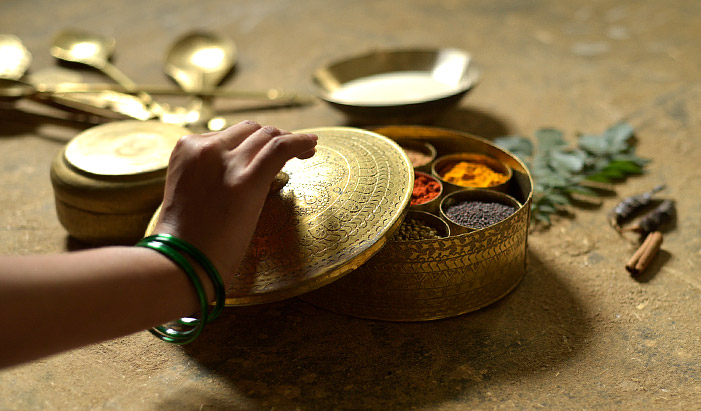
Brass has been the primary domestic metal in Indian homes for longer than almost any other material in continuous use. It holds heat evenly, which is why it remains the preferred vessel for certain cooking traditions. It is naturally antimicrobial, which is why it was used for water storage and food preparation before anyone had the vocabulary to explain why. And it develops a patina over years of use — a warm, darkening quality in the recesses and a brighter warmth at the high points — that makes a well-used brass object look more alive, not more worn.
A handcrafted brass gift set for a new home is the most immediately useful artisan gift on this list. A hand-finished masala dabba — the spice box with individual compartments for the daily spices that every Indian kitchen requires — is used from the first morning in the new home, and used every day thereafter. A set of brass diyas in graduated sizes serves both the puja room and the entrance on every significant occasion. A brass serving bowl or water vessel brings material quality to the dining table. These are objects whose function is inseparable from their form, made by communities in Moradabad and Thanjavur who have been producing brassware for the Mughal courts and temple traditions respectively for several centuries. The craft and the purpose are the same age.
Price range: ₹500 – ₹4,500 | Explore Brass on Gaatha →
10. DHANA MURTI
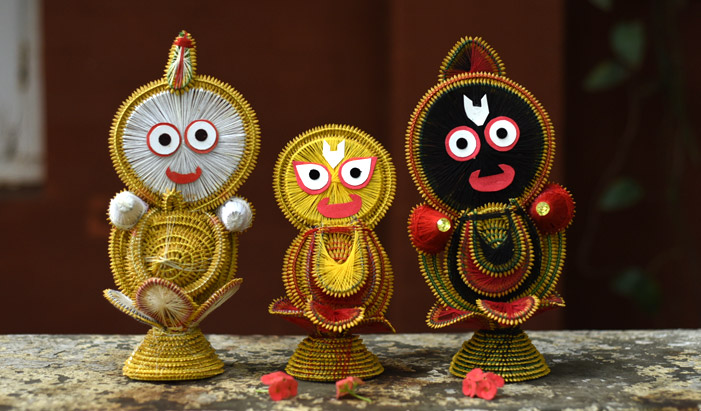
Dhana Murti, or idols made from unpeeled rice grains, is a distinctive craft rooted in regional traditions where everyday materials are transformed into objects of devotion and beauty. The process uses three simple elements — rice grains, thin bamboo slivers, and colored cotton threads. The bamboo is first soaked in turmeric water and sun-dried to make it flexible, after which rice grains are carefully looped and secured between the slivers using thread. These delicate strands are then shaped and coiled into intricate forms, often depicting Indian gods and goddesses, reflecting both skill and cultural symbolism.
As a gift for a new home, a Dhana Murti carries a rare combination of material uniqueness and spiritual meaning. Its fine, handcrafted structure creates a visual lightness, while the use of rice — a symbol of abundance and prosperity in Indian culture — adds deeper significance. Placed in a living space or puja corner, it enhances the aesthetic with its detailed form while also bringing a sense of auspiciousness. It is not just a decorative object, but a thoughtful expression of tradition, making it a meaningful addition to any home.
Price range: ₹900 – ₹3,500 | Explore Block Print on Gaatha →
ON GIFTING AND THE HOME
The pattern repeats at every Griha Pravesh: the practical gifts are used and forgotten. The objects that carry a story — that require a moment of explanation, that give the recipient something to say when a guest asks about them — are the ones that remain. A new home is, among other things, a collection of such moments in waiting. Every object on a shelf or a wall will eventually become the answer to someone's question.
The ten crafts in this guide were chosen because each one earns that question. A Kaavad opens. A Dhokra's surface bears the record of its own making. A Pichwai changes meaning when you learn which festival it was originally painted for. A Chhau mask was built to perform. A bead toran was hung, by tradition, before the family crossed their own threshold for the first time. These are not decorations. They are presences — objects with a reason for being exactly what they are, in exactly the space where they now stand.
Gaatha documents the origin, technique, and community behind every craft we carry. When you give from Gaatha, the story travels with the object — and it is the story, more than anything else, that the new home will remember. Browse the complete collection at shop.gaatha.com →
Vastu-aligned gifting: what the traditions actually say
Vastu Shastra has specific associations with materials, symbols, directions, and objects for new homes. If your recipient observes Vastu principles — and many Indian homeowners do, at least partially — the following is directly relevant to your gift choice.
The door and the toran: The entrance is the most Vastu-sensitive point in any home. Vastu recommends keeping the main door clear, bright, and decorated with auspicious symbols to welcome positive energy and prosperity. A handmade bead toran hung at the main door is the single most Vastu-aligned gift on this list — designed specifically for this threshold, its mirrors, bells, and colours are all traditional markers of welcome and protection in Indian spatial tradition.
Metals and direction: Brass and copper are Vastu-positive metals for the east and northeast of a home, associated with sunrise, new beginnings, and the water element. A brass diya set or Dhokra sculpture at the entrance (ideally facing east or northeast) is particularly auspicious for a Griha Pravesh. A brass masala dabba in the kitchen aligns with the southeast (Agni/fire direction), the correct Vastu zone for cooking and nourishment.
The lotus motif: The lotus in Pichwai paintings is the central symbol of Lakshmi, the goddess of wealth and abundance. Placed on a north-facing wall — the wealth zone in Vastu — a Pichwai with lotus imagery aligns aesthetics with spatial philosophy in a way that is both beautiful and intentional.
Storytelling and auspicious narrative: The Kaavad's panels depict the arc of mythological stories that have been considered auspicious for domestic spaces for centuries. A Kaavad in the living room or puja corner introduces sacred narrative into the home's visual environment — exactly what Vastu recommends for spaces dedicated to gathering and worship.
What to avoid: Gifts depicting solitary animals, battle scenes, or crying figures are considered Vastu-inauspicious for new homes. Every craft in this guide carries auspicious or neutral imagery — dancing figures (Kaavad, Chhau), abundance motifs (Pichwai), light (brass diyas), and sacred stories (Raja Ravi Varma prints). None carry negative associations in any regional Indian tradition.
FREQUENTLY ASKED QUESTIONS
What are the best Indian handicraft gifts for a new home?
The best Indian handicraft gifts for a new home include Dhokra brass sculptures (Odisha/West Bengal), Pichwai paintings (Nathdwara, Rajasthan), Madhubani paintings on handmade paper (Bihar), a Kaavad wooden storytelling shrine (Rajasthan), handmade bead toran door hangings (Gujarat/Rajasthan), Chhau or wooden masks, Raja Ravi Varma heritage prints, Bidriware metalwork (Karnataka), traditional brass home and kitchen sets, and block print cotton textiles. Each carries a documented craft tradition and adds lasting character to a home.
What is a Kaavad and why is it a good housewarming gift?
A Kaavad is a portable wooden shrine from Bassi, Rajasthan, painted with scenes from Hindu mythology and folk tales. Traditionally carried by Kaavadiya Bhat storytellers who narrated epics door-to-door, each hinged panel opens to reveal a new chapter of the story. As a housewarming gift it is exceptional — visually striking, deeply Indian, a guaranteed conversation starter, and functional as both a decorative object and a portable temple. No other Indian craft combines storytelling and spiritual function in the same form.
What is a toran and why is it hung at the door of a new home?
A toran is a decorative door hanging used across India to mark auspicious occasions and welcome positive energy into a home. Hanging a toran at the entrance is one of the very first rituals of Griha Pravesh. Handmade bead and mirror-work torans from Gujarat and Rajasthan are permanent artisan-made versions designed to hang for years, making a handmade toran one of the most contextually meaningful gifts for a new home. They can also be hung at the entrance of the pooja ghar within the home.
What is a good budget for an Indian handicraft housewarming gift?
For ₹500–₹1,500: small Madhubani prints, bead toran, brass diya set, block print cushion covers. For ₹1,500–₹4,000: medium Dhokra sculpture, Chhau mask, framed Pichwai or Raja Ravi Varma print, brass masala dabba, small Kaavad. For ₹4,000–₹12,000: original Pichwai painting, large Dhokra piece, Bidriware vase, detailed multi-panel Kaavad. All prices reflect artisan labour hours, not just material cost.
Where can I buy authentic Indian handicrafts online?
Authentic Indian handicrafts can be bought from platforms that work directly with artisan clusters and document craft provenance. Gaatha Handicrafts (shop.gaatha.com) is one of India's longest-standing craft research and retail platforms — every product in the catalogue is sourced from verified artisan communities, with documented craft origin stories available for each category.
Leave a Comment